Common questions
Tattoo and Permanent Makeup Removal: Common Questions
Explore common tattoo and permanent makeup removal questions, including methods, consultations, risks and aftercare.
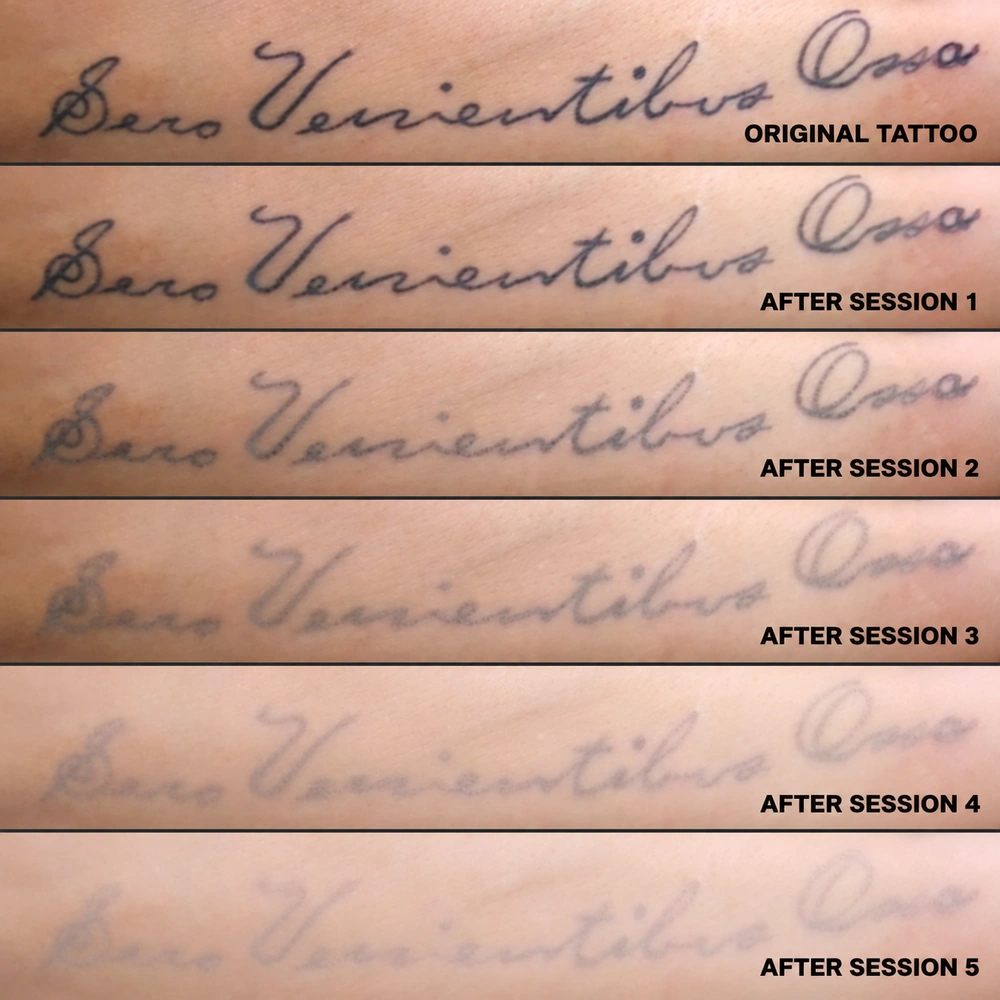
Which removal method does the course teach?
The Skinart online tattoo removal course teaches the saline syrem rejection method, not laser removal. The general questions below also discuss laser treatments; those answers do not describe the course syllabus or qualify a student to operate a laser. Use the regional course link below to check the current outline before enrolling.
Questions and answers
Browse the questions below. For current training details, choose your region at the end of the page. Personal treatment suitability should be discussed with an appropriately qualified practitioner.
1. What is tattoo removal?
Tattoo removal is a procedure to fade or completely eliminate an existing tattoo on the skin. The most common method is laser tattoo removal, which breaks up the ink particles so they can be eliminated by the body's immune system.
2. How does laser tattoo removal work?
Laser tattoo removal uses pulses of light at different wavelengths to break down the ink particles in your tattoo. These shattered ink particles are then removed naturally by your body's immune system.
3. Is tattoo removal painful?
Yes, it can be uncomfortable, but the level of pain often depends on the individual's pain threshold. Many people describe the sensation as similar to a rubber band being snapped against the skin.
4. How many sessions are required to remove a tattoo?
The number of sessions depends on the tattoo, pigment and individual response. Multiple treatments may be needed, and complete removal is not always possible. Ask the treating clinician for an individual assessment rather than relying on a fixed session count.
5. How long does each session take?
Each session can last anywhere from a few minutes to an hour, depending on the size and complexity of the tattoo.
6. What is the cost of tattoo removal?
Ask for a current local quote after the tattoo has been assessed. Costs depend on the method, area treated and number of visits; clarify consultation, aftercare and repeat-treatment charges. Treatment quotes are separate from the training course prices linked below.
7. Is tattoo removal safe?
Tattoo removal carries risks, including scarring and infection. An appropriately qualified professional can assess the tattoo, explain suitable options and discuss the risks; a successful or complication-free result cannot be guaranteed.
8. What are the potential side effects of tattoo removal?
Possible effects include redness, swelling, blistering, infection and scarring. Lighter or darker skin patches can also occur and may persist. Ask the treating clinician which risks apply to your skin and method.
9. Can all tattoos be completely removed?
While most tattoos can be significantly faded, not all can be completely removed. Factors such as ink depth, type of ink used, and color can affect the results.
10. Does tattoo removal leave scars?
Scarring is a possible complication of tattoo removal. The risk depends on the method, skin, treatment settings and healing, and cannot be ruled out by using a newer device. Ask the treating clinician to assess your individual risk.
11. Does tattoo color affect removal?
Yes, different colors absorb different wavelengths of light, making some colors harder to remove than others. For instance, black and dark blue tattoos are usually easier to remove, while colors like green and yellow can be more challenging.
12. What should I do before a tattoo removal session?
Discuss your health history, medicines and supplements with the treating clinician before booking. Do not stop or change prescribed medication unless your prescribing clinician advises it. Follow the individual preparation instructions provided after assessment.
13. How long should I wait between sessions?
The treating clinician should set the interval after assessing your skin, method and response. Your skin needs time to heal, and pigment clearance continues between laser visits. Do not shorten the interval or treat unhealed skin to try to speed up removal.
14. Can I remove a tattoo at home?
Do not attempt tattoo removal with home kits, acids, salt abrasion or removal creams. These can injure the skin without reliably removing the pigment. An appropriately qualified clinician can assess the tattoo and explain suitable options and risks.
15. Can I remove a new tattoo?
Have the new tattoo assessed before planning removal. The skin must heal first, and a fixed six-week date is not automatic clearance. The treating clinician should advise when treatment is appropriate for your skin and the proposed method.
16. Can I remove a tattoo if I have dark skin?
Darker skin can be treated in suitable cases, but it needs careful assessment and an appropriately experienced clinician. Laser choice and settings matter because skin pigment can also absorb energy. Discuss the risks of lighter or darker patches, scarring and the likely treatment plan before proceeding.
17. Is tattoo removal covered by insurance?
Most insurance plans do not cover tattoo removal as it is considered a cosmetic procedure.
18. What can I expect after a tattoo removal session?
Redness, swelling, tenderness or blistering can occur, but recovery varies. Follow the written aftercare instructions. Contact the treating clinician if symptoms worsen or healing is delayed; seek urgent medical advice for spreading redness, pus, fever or feeling seriously unwell.
19. Can I get a new tattoo after removal?
Yes, but you should wait until the treated area is fully healed, which can take several months after the final removal session.
20. What is the aftercare for tattoo removal?
Aftercare generally includes keeping the area clean, avoiding sun exposure, and not picking at any blisters or scabs that may form.
21. Can a partially removed tattoo be retouched?
Yes, many people choose to modify or touch up a tattoo rather than removing it completely. It's essential to wait until your skin has fully healed before getting a new tattoo.
22. Why is the tattoo darker after treatment?
Some pigments, particularly those used in cosmetic tattoos or light-coloured inks, can darken after laser treatment. This is not guaranteed to be temporary or to improve with more sessions. Ask the treating clinician to assess the change before further treatment.
23. What happens to the ink after it's broken down?
After the laser breaks down the ink particles, your body's immune system flushes them out naturally.
24. Why is tattoo removal expensive?
Tattoo removal is a complex process that requires specialized equipment and trained professionals. The cost reflects these factors as well as the number of sessions required.
25. Can I just fade my tattoo instead of complete removal?
Yes, it's possible to fade a tattoo with fewer treatment sessions if you're planning to cover it with another tattoo.
26. What are alternatives to laser tattoo removal?
Options depend on the tattoo and may include surgical excision or other specialist methods. Each has different limitations and scarring risks; do not try acids, abrasion or home removal kits. Discuss alternatives with a qualified clinician. The Skinart course linked here covers saline syrem rejection, not laser operation.
27. Does tattoo removal cream work?
Do not rely on creams or home kits to remove tattoo pigment. The FDA has not approved these products for tattoo removal and reports no evidence that they are safe and effective for this purpose. They can cause burns, rashes or scarring.
28. What kind of laser is used for tattoo removal?
Tattoo-removal lasers deliver very short pulses of energy to fragment pigment. Devices and wavelengths are selected for the ink colours and skin being treated; suitability is not determined simply by producing a higher temperature.
29. Why do I have to wait between treatment sessions?
Waiting between sessions allows your body to flush out the broken down ink and for the skin to heal.
30. Is tattoo removal faster than getting a tattoo?
No, tattoo removal typically requires multiple sessions spread over several months, making it a longer process than getting a tattoo.
31. Is the tattoo removal laser harmful to my health?
Laser tattoo removal is not risk-free. Possible complications include scarring, infection and changes in skin colour. A qualified treating clinician should assess your suitability and explain the risks before treatment.
32. Will tattoo removal work on a tattoo cover-up?
It can work, but since cover-ups often use more and denser ink, they can be harder and take longer to remove.
33. What happens if I don’t finish my tattoo removal treatments?
The tattoo may remain partly faded, and the amount of pigment left varies. Completing a planned course of treatment does not guarantee complete removal either. Discuss your result, risks and whether further treatment is worthwhile with the treating clinician.
34. Why do some tattoos leave a "ghost" image even after removal?
This can occur due to the depth of the ink, type of ink used, or individual skin characteristics. It's the remaining trace of the tattoo, often lighter than the original.
35. Can I exercise after tattoo removal?
Ask the treating clinician when to resume strenuous exercise, swimming and activities that cause friction or heavy sweating. Timing depends on the treated area and healing; do not treat a 24-48-hour interval as suitable for everyone.
36. What factors make a tattoo harder to remove?
Tattoo age, color, type of ink, tattoo location, depth of ink, and individual's skin type can affect how easily a tattoo can be removed.
37. Do small tattoos take less time to remove?
A smaller tattoo may take less time to treat at each visit, but size alone does not determine the number of sessions. Ink colour, density, depth, location and individual response also matter.
38. What does tattoo removal feel like?
Most people compare the sensation to a rubber band snapping against the skin.
39. How do I know if tattoo removal is right for me?
Start with a consultation covering your health, medicines, skin, tattoo and expectations. Discuss likely fading, treatment time, cost and risks, including the possibility of incomplete removal. An assessment helps you decide whether to proceed, wait or consider another option.
40. What's the difference between PicoSure, Q-switched, and other lasers?
These devices differ in pulse duration, wavelength and other characteristics. PicoSure is a brand of picosecond laser; conventional Q-switched tattoo lasers commonly use nanosecond pulses. No device is automatically best for every tattoo. The pigment, skin and clinician's assessment determine the appropriate approach.
41. What is the R20 method in tattoo removal?
The R20 method involves performing multiple laser passes during a single treatment session with 20-minute intervals, allowing more ink to be broken down.
42. What is the R0 method in tattoo removal?
R0 is a specialist multiple-pass laser approach using perfluorodecalin to reduce the temporary whitening that follows a laser pass, allowing shorter intervals between passes. It is not simply repeated laser exposure without a pause; suitability and the protocol require a qualified clinician's assessment.
43. Can tattoos be removed in one session?
It's very rare for a tattoo to be fully removed in one session. Multiple sessions are typically needed, especially for larger or more colorful tattoos.
44. What types of tattoos are the easiest to remove?
Black ink tattoos and those done by amateurs are generally easier to remove because the ink is often less dense and not as deep in the skin.
45. Is tattoo removal a surgical procedure?
Laser removal does not involve cutting out the tattooed skin. Surgical excision is a different removal method that does involve an operation and leaves a scar. Ask which method is being proposed and what its risks and recovery involve.
46. Can a tattoo removal cause cancer?
Do not interpret an absence of proven causation as a guarantee of zero long-term risk. Research into tattoo pigments and their breakdown products is ongoing. Have a dermatologist assess any changing mole, lump or other suspicious skin change before removal; treatment may need to wait for investigation.
47. Can a removed tattoo come back?
Once a tattoo is fully removed, it does not come back. However, incomplete removal may leave a ghost or faded image.
48. What happens if I get a tan on the treated area?
Tanning can lead to pigmentation changes in the treated area and is generally not recommended during the tattoo removal process.
49. Can I remove a cosmetic tattoo (like microbladed eyebrows)?
Cosmetic tattoos require specialist assessment: some pigments can darken with laser treatment, and complete removal is not guaranteed. Work near the eyes needs appropriate eye protection and expertise. Discuss the pigment, location and proposed method with a qualified clinician before proceeding.
50. Can I get tattoo removal if I'm pregnant?
Tattoo removal is generally not recommended during pregnancy due to the lack of research on how the laser energy and eliminated ink can affect the developing fetus.
Compare your training options
Explore our body-art subject guide, compare online and practical learning, or contact the team about a course.
Explore the current training options
Choose your region to review local course details, prices and enrolment terms on Skinart Training.